How The Dictatorship Of Capitalist Consumerism Created A Nation Of Disengaged Dropouts With Zero Interest In Learninghttps://newsfrombarbaria.blogspot.com/2025/09/how-dictatorship-of-capitalist.html
Unregulated "Cowboy" Capitalism (In Memes): Capitalism Is The Foremost Propellant Of Moral And Environmental Degradation In America And In The World -- A Propellant Rendered Nearly Invisible By Plutocrats (And Now, Kakistocrats) Who "Divide And Conquer" Via The Idiocracy's Age-Old Manipulation Of Public Opinion
G.K. Chesterton on Donald Trump, The Quinessential Dullard
19 Surprisingly Critical Thoughts On Money And Capitalism From US Presidents
We expect populism from certain famous presidents — the anti-bank Andrew Jackson, the trust-busting Theodore Roosevelt, the class traitor FDR — but it can be jarring to read an indictment of capitalism from such a stolid symbol of American power as Thomas Jefferson or Abraham Lincoln. Of course, talk is cheap, and politics expensive; most of these quotations were not given from the so-called bully pulpit of the presidency. Still, they remind us that our present discourse, in which redistribution is a dirty word, is something contingent, not essentially American.
Remember the outcry after President Barack Obama criticized “fat cat bankers on Wall Street” in 2009? As we’re about to see, that comment was actually pretty tame, by historical standards. Here are 19 remarkable thoughts on money and the public good from American presidents.
George Washington on regulation
From trade our citizens will not be restrained, and therefore it behoves us to place it in the most convenient channels under proper regulations, freed as much as possible from those vices, which luxury, the consequence of wealth and power, naturally introduces.
John Adams on the fourth estate
The preservation of the means of knowledge among the lowest ranks is of more importance to the public than all the property of all the rich men in the country. It is even of more consequence to the rich themselves and to their prosperity. The only question is whether it is a public emolument; and if it is, the rich ought undoubtedly to contribute in the same proportion as to all other public burdens–that is, in proportion to their wealth, which is secured by public expenses.
Thomas Jefferson on corporations
I hope we shall take warning from the example [of England] and crush in its birth the aristocracy of our monied corporations which dare already to challenge our government to a trial of strength and bid defiance to the laws of our country.
James Madison on marketmakers
The stock-jobbers will become the pretorian band of the Government, at once its tool & its tyrant; bribed by its largesses, & overawing it by clamours & combinations.
Andrew Jackson on the influence of money
It is to be regretted that the rich and powerful too often bend the acts of government to their selfish purposes.
Abraham Lincoln on bailouts
These capitalists generally act harmoniously and in concert to fleece the people, and now that they have got into a quarrel with themselves, we are called upon to appropriate the people’s money to settle the quarrel.
Ulysses S. Grant on financial lawlessness
The banks may violate the law and be sustained in doing so. But the President of the United States cannot violate the law.
Rutherford B. Hayes on corporate tyranny
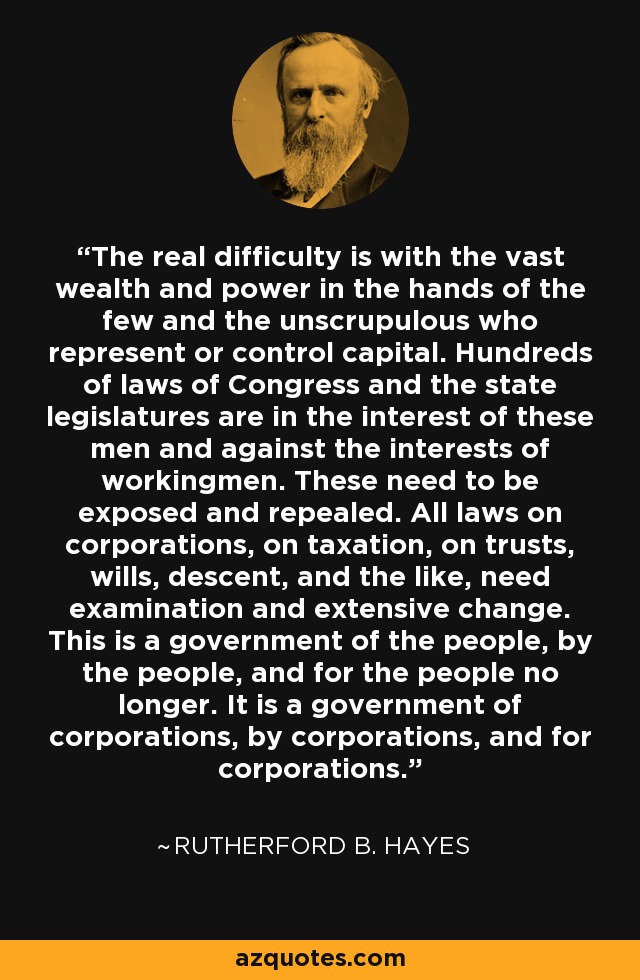
The real difficulty is with the vast wealth and power in the hands of the few and the unscrupulous who represent or control capital. Hundreds of laws of Congress and the state legislatures are in the interests of these men and against the interests of the workingmen. These need to be exposed and repealed. All laws on corporations, on taxation, on trusts, will, descent, and the like, need examination and extensive change. This is a government of the people, by the people, and for the people no longer. It is a government of corporations, by corporations, and for corporations. — How is this?
Grover Cleveland on capitalism
Communism is a hateful thing and a menace to peace and organized government; but the communism of combined wealth and capital, the outgrowth of overweening cupidity and selfishness, which insidiously undermines the justice and integrity of free institutions, is not less dangerous than the communism of oppressed poverty and toil, which, exasperated by injustice and discontent, attacks with wild disorder the citadel of rule.
Theodore Roosevelt on redistribution
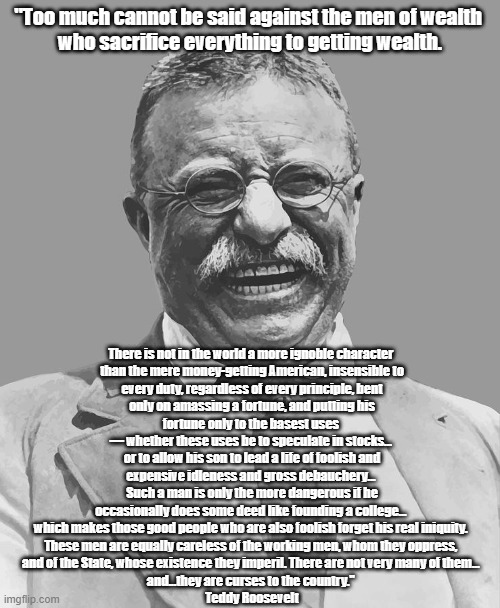
A heavy progressive tax upon a very large fortune is in no way such a tax upon thrift or industry as a like would be on a small fortune. No advantage comes either to the country as a whole or to the individuals inheriting the money by permitting the transmission in their entirety of the enormous fortunes which would be affected by such a tax; and as an incident to its function of revenue raising, such a tax would help to preserve a measure of opportunity for the people of the generations growing to manhood.
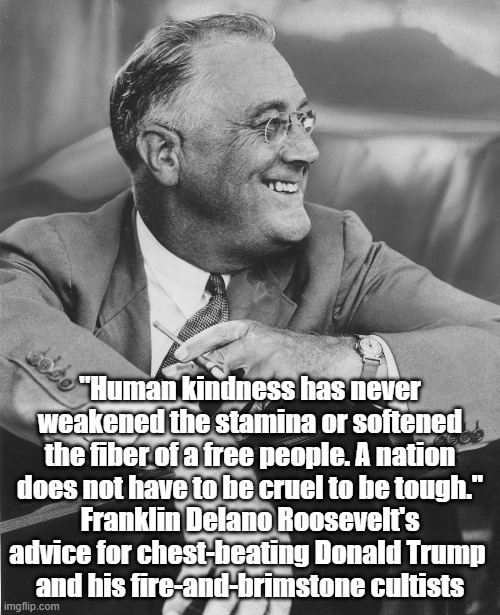
Franklin D. Roosevelt on organized money
We had to struggle with the old enemies of peace–business and financial monopoly, speculation, reckless banking, class antagonism, sectionalism, war profiteering. They had begun to consider the government of the United States as a mere appendage to their own affairs. We know now that Government by organized money is just as dangerous as Government by organized mob.

Harry Truman on greed
We worship money instead of honor. A billionaire, in our estimation, is much greater in these days in the eyes of the people than the public servant who works for public interest. It makes no difference if the billionaire rode to wealth on the sweat of little children and the blood of underpaid labor. No one ever considered Carnegie libraries steeped in the blood of the Homestead steelworkers, but they are. We do not remember that the Rockefeller Foundation is founded on the dead miners of the Colorado Fuel & Iron Company and a dozen other similar performances. We worship Mammon… It is a pity that Wall Street, with all its ability to control all the wealth of the nation and to hire the best law brains in the country, has not produced some statesmen, some men who could see the dangers of bigness and of the concentration of the control of wealth. Instead of working to meet the situation, they are still employing the best law brains to serve greed and self-interest. People can only stand so much, and one of these days there will be a settlement…
John F. Kennedy on the president’s role
The responsibility of the President, therefore, is especially great. He must serve as a catalyst, an energizer, the defender of the public good and the public interest against all the narrow private interests which operate in our society.
Richard Nixon on welfare
What I am proposing is that the federal government build a foundation under the income of every American family with dependent children that cannot care for itself–and wherever in America that family may live.
Jimmy Carter on economic philosophy
Powerful lobbyists, both inside and outside government, have distorted an admirable American belief in free enterprise into the right of extremely rich citizens to accumulate and retain more and more wealth and pass all of it on to descendants. Profits from stock trading and dividends are being given privileged tax status compared to the wages earned by schoolteachers and firemen. To quote a Christian friend, the new economic philosophy in Washington is that a rising tide raises all yachts.
Ronald Reagan on organized labor
Where free unions and collective bargaining are forbidden, freedom is lost!
George H. W. Bush on working in finance
I want to know and understand people, but the people I’d be doing business with in the investment business, I know to some degree now. I am not sure I want to capitalize completely on the benefits I received at birth–that is on the benefits of my social position. Such qualities as industriousness, integrity, etc. which I have or at least hope I have had inculcated into me by my parents, at least to some degree, (I hope) I do want to use, but merely doing well because I have had the opportunity to attend the same debut parties as some of my customers, does not appeal to me.
Bill Clinton on studying business law
I redeemed myself in Corporate Finance when I aced the final exam. When Professor Chirelstein asked me how I could be so good at Corporate Finance but bad at Taxation, I told him it was because corporate finance was like politics: within a given set of rules, it was a constant struggle for power, with all parties trying to avoid getting shafted but eager to shaft.
George W. Bush on Wall Street
For most of my time at Harvard, I had no idea how I was going to use my business degree. I knew what I did not want to do. I had no desire to go to Wall Street. While I knew decent and admirable people who had worked on Wall Street, including my grandfather Prescott Bush, I was suspicious of the financial industry. I used to tell friends that Wall Street is the kind of place where they will buy you or sell you, but they don’t really give a hoot about you so long as they can make money off you.
–Written by Eamon Murphy for MainStreet

No comments:
Post a Comment