
Alan and Cynthia in Marrakesh
March, 2026


A Murmuration Of Motorbikes
On February 16, 2026, Cynthia and I flew from Madrid to Marrakech to "winter over" in a more clement climate than Chicago, and also to be close to Cynthia's sister, Krissy, who spent the first five days of our sojourn with us in Madrid, walking the grand boulevards and viewing the extraordinary art at El Prado and Museo Reyna Sofia.
El Prado: https://en.wikipedia.org/wiki/Museo_del_Prado
Museo Reina Sofia:
Before adverse circumstances overwhelmed us in Marrakech, we planned to reside with Krissy in her Basque Country home near Biarritz during our last two weeks of travel in Europe and North Africa.

The Atlas Mountains (a Berber stronghold) seen from the front window of Anis' van-cab

Cynthia and Anis looking out on the snow-covered Atlas Mountains, south of Marrakech
We were met at the Marrakech airport and driven into town (with the snow-covered Atlas mountains in the near distance) by our "mountain Berber" driver, Anis -- a tall, handsome 23-year-old who moonlighted as a blues singer. Anis was a peaceful, warm-hearted soul who joined me, most amiably, in a duet rendition of Ben E. King's "Stand By Me." Great fun!
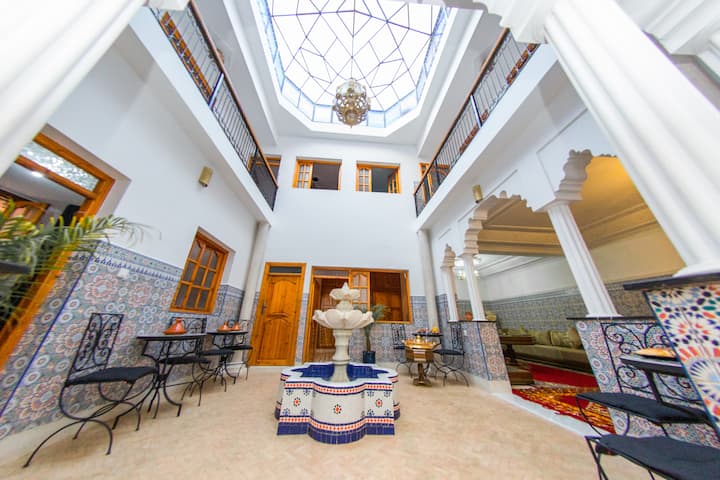
Breakfast Room at Riad Dahab
with Travellers' Common Room off to the right.
(Common Room photo enlarged below)

Riad Dahab's rooftop pool


The front door to Riad Dahab, our bathroom and bedroom windows immediately above.
Notice that there is no signage.
Delivered safely to our lodging, Riad Dahab enchanted us at once, as did the lovely Moroccan woman, Camelia (a former breast and prostate cancer researcher in Montreal), who was our “hostess.”
N.B. A "riad" is a centuries-old "mansion," usually located within the ancient walls of Marrakesh, a building whose rooms lodge travellers. Typically, visitors are treated to a hearty breakfast in the ground-floor atrium, whose glass cupola spans the common gathering space two or three storeys above. A riad's inside walls are covered with ceramic tiles emblazoned with interlocking geometrical patterns. Except for a riad's elaborate wooden entrance doors - with even more elaborate hand-crafted bronze knockers - a riad's outer walls are drab. It is noteworthy that two of the three Abrahamic religions, Judaism and Islam pay close attention to the First Commandment's prohibition of any "real-world images," be they representations of humans, animals, fish, birds, plants, trees. And because this prohibition is taken so seriously, there is, traditionally, NO representative artwork, but instead, ever-present, endlessly ramifying geometric objet d'arte.
“‘Never make idols; don’t worship images, whether of birds, animals, or fish. 9-10 You shall not bow down to any images nor worship them in any way, for I am the Lord your God. I am a jealous God, and I will bring the curse of a father’s sins upon even the third and fourth generation of the children of those who hate me; but I will show kindness to a thousand generations of those who love me and keep my commandments."
Deuteronomy 5:8-10

Our first full day in Marrakech, Cynthia and I wandered toward the medina (old market), soon locating a narrow passageway - thick with pedestrians and motorbikes and flanked by proliferating souks (market stalls that were rarely more than 20 feet wide) - a sprawling maze that suddenly opened upon a bustling esplanade, replete with snake charmers, acrobats, drummers, dancers, enchanting "oud" music, and all manner of inexplicable performers, including a man stationed at a table overflowing with human teeth and antique dental tools - a hubbub of activity known as Jamaa el-Fnaa. https://en.wikipedia.


God knows...


The Oud is a string instrument that produces Morocco's most haunting (and arguably most identifiable) music.
Oud sample: https://www.youtube.com/watch?v=c7WskrXe1ac


Moroccans are devout Muslims.
But they are neither hidebound nor jihadist.

Although I did not know it the first time I visited Jamaa el Fnna, this exuberant market Square was overlooked by a 13-story high medieval mosque called Koutoubia, situated a quarter mile west of the esplanade in the heart of medieval Morocco.

Marrakech, with the fishing village of Essouira due west.
Tangiers, on the south side of the Straits of Gibraltar, is 350 miles
almost due north.
The snow-covered peaks seen in an earlier photo are in the Atlas mountain range, overlooking Asni, south of Marrakech
That first day’s expedition found us in fine fettle, exploring, planning day trips to outlying ethnic enclaves and craft centers. We contemplated an overnight in Essouira, an Atlantic fishing village 3 hours west of Marrakech.
But by the end of our second full day in Morocco, Cynthia’s energy was waning.

Looking down from the dining area atop Andalusia-Morocco Restaurant

Andalusia-Morocco rooftop restaurant, with Koutubia in the background - and the medina-souk-maze in between.
The next night, Cynthia was barely able to walk the half-kilometer from our riad to "Andalusia-Morocco Restaurant," whose young manager (and extended family) took us in as if we were kin.
Owner Agnan was a 30-ish fellow whose Dad recently gifted him the building. He and I became quite close, quite quickly, bonding around the music of Bob Marley who is very popular in Marrakech. Agnan told me that the restaurant's name included a reference to Andalusia, the Moorish part of southern Spain: his family was among innumerable Moors and Jews whom Ferdinand and Isabella expelled from Spain in 1492 as the single most decisive act of the re-conquista.

Karim, the multilingual eggplant roaster (and all-round amiable guy) at Andalusia- Morocco Restaurant.
This polyglot genius spends his days roasting eggplant, and is quite likely happier than I.
You better get yourself together
Pretty soon, you're gonna be dead
Instant karma's gonna get you
Gonna knock you off your feet
Better recognize your brothers
Everyone you meet
Come and get your share
Instant Karma
John Lennon
Lennon's recording: https://www.youtube.com/watch?v=xLy2SaSQAtA
*****
In memory of Ferdinand and Isabella's expulsion of Semites in 1492, here is a synopsis of an astonishing, if not epochal, act of kindness evoked by the reyes catolicos' cruelty:
Excerpt: In July 1492, the new state of Spain expelled its Jewish and Muslim populations as part of the Spanish Inquisition. Bayezid II sent out the Ottoman Navy under the command of admiral Kemal Reis to Spain in 1492 in order to evacuate them safely to Ottoman lands. He sent out proclamations throughout the empire that the refugees were to be welcomed.[13] He granted the refugees the permission to settle in the Ottoman Empire and become Ottoman citizens. He ridiculed the conduct of Ferdinand II of Aragon and Isabella I of Castile in expelling a class of people so useful to their subjects. "You venture to call Ferdinand a wise ruler," he said to his courtiers, "he who has impoverished his own country and enriched mine!"[14] Bayezid addressed a firman to all the governors of his European provinces, ordering them not only to refrain from repelling the Spanish refugees, but to give them a friendly and welcome reception.[14] He threatened with death all those who treated the Jews harshly or refused them admission into the empire. Moses Capsali, who probably helped to arouse the sultan's friendship for the Jews, was most energetic in his assistance to the exiles. He made a tour of the communities and was instrumental in imposing a tax upon the rich, to ransom the Jewish victims of the persecution.
The Muslims and Jews of al-Andalus (present-day Andalusia) contributed much to the rising power of the Ottoman Empire by introducing new ideas, methods and craftsmanship. The first printing press in Constantinople (now Istanbul) was established by the Sephardic Jews in 1493. It is reported that under Bayezid's reign, Jews enjoyed a period of cultural flourishing, with the presence of such scholars as the Talmudist and scientist Mordecai Comtino; astronomer and poet Solomon ben Elijah Sharbiṭ ha-Zahab; Shabbethai ben Malkiel Cohen, and the liturgical poet Menahem Tamar. https://www.

Agnan
That night, after a pleasant dinner at Agnan's restaurant, Cynthia was able to walk “home,” but very slowly to conserve her waning energy.

The next day, I watched Cynthia become weaker and weaker - coughing harder and harder - until, over the course of the next 48 hours, she did not leave the riad at all - and was barely able to descend a flight of stairs to partake of our sumptuous breakfast in the magnificently tiled, glass-covered atrium.
For three days, I watched Cynthia weaken by slight increments, but because she is an eager soul, her spirit remained buoyant, even as I witnessed her decline.
If I had taken the time to analyze the situation rationally - and if I had been removed from the immediacy of circumstances that made it easy to "hope for the best" - I would have realized that the obvious course of action would have been a medical consultation sooner rather than later.
But I was encouraged by the unspoken hope that the tide would turn, and all would be well.
By our fourth full day in Marrakech, I realized that I really must consult with Cynthia‘s sister Krissy, a former nurse who had lived 35 years in the Basque Country of southwestern France.
That morning, I wrote a long, considered email to Krissy and waited for opportunity to read it aloud to Cynthia in order to reveal (and rationalize) how I now thought it crucial to locate a good physician.
As it happened, Krissy (who was communicating with Cynthia daily) was having similar thoughts that medical intervention was now necessary.

Riad Dahab owner-manager Camelia, and her "go-to" driver, Anis, help Cynthia and me load luggage into our lodging
Over the course of several hours - and with the crucial help of Camelia (our riad owner/manager) we decided to take Cynthia to a northside clinic, operated by Camelia's friend, Dr. Zakaria.
For some while, Cynthia and I foolishly hoped that Dr. Zakaria would simply bring his black bag to our riad and prescribe curative medicines that Cynthia could take by mouth.
In the end, it was clear that we had been overwhelmed by a force majeure, and Camelia ordered a cab to come fetch us.
Apparently, there was some legal prohibition preventing the cab from driving down the side street where we were lodged, about 200 yards from the main road, directly across from the entrance to Marrakesh's largest park (and orchard), Parc Agdal ba Hmad.
Walking those 200 yards to the main road was an enormous challenge, as there was no place for Cynthia to sit if it became impossible for her to carry on.
In the end, Cynthia had to plop herself down on a large, overgrown flower pot, thick with weeds.
Minutes later, the cab arrived, and it was discouraging to see that Cynthia had to struggle to get up into the taxi's back seat.

Main Entrance, Clinique Averroes
Clearly, our arrival at Clinique Averroes would not conclude with a perfunctory check-up and prescription of an oral antibiotic. Cynthia's labored breathing and extreme enervation would require emergency assessment and hospitalization.

Reception Desk
Upon arrival at Clinique Averroes, we were approached from behind -- while still checking in at reception -- by a young, bearded, long-haired physician who spoke perfect English. Dr. Ghali asked important, penetrating questions while sweeping us both into the bowels of the building.
We passed through several card-activated sliding glass doors, and in no time Cynthia was lying on a state-of-the-art, rollable hospital bed, dressed in an open-backed blue gown, an IV connected to a skillfully inserted port, electrodes attached to her torso.
It turned out that Dr. Ghali (a huge fan of Tolkien's "Lord of the Ring" trilogy) was a certified ER doc. He exuded calm, knowledgeability, and expertise.

Dr. Montero preparing to move Cynthia from the ER to CAT scan imaging
As soon as Cynthia’s EKG was complete, another young physician (a Spanish- French- and Arabic-speaking sub-Saharan black man from Guinea-Bissau) whisked Cynthia through another set of electronically-gated doors, while I was guided to a nearby waiting room.
An hour later - now in simple, civilian clothes, but with stylish red tennis shoes and waaayyyy cool sunglasses (reminiscent of Cynthia’s own red-framed readers), Dr. Montero found me in the waiting room.
He sat on the sofa alongside me, smiled amiably, and, resting his hand on my knee, said - emphatically - “Your wife will be fine.”
I was astonished that he could make such a self-assured claim, but as if reading my mind, he repeated - again with complete confidence - “Cynthia will be fine. The CAT scan reveals severe pneumonia in both lungs, and there is an irregularity that looks like some small blockage in her left lung, but we have her on antibiotics and an anticoagulant (?).
(Although it did not become clear until 2 weeks later that atrial fibrillation was discovered during Cynthia’s workup, it could be that Dr. Montero was not referring to an anticoagulant but to the blood thinner Eliquis.)

Oil painting in Averroes lobby
I was hugely relieved by Clinique Averroes' adept diagnosis and superb treatment of Cynthia.
Within two hours of admission, Cynthia was installed in her own private, spacious, artfully decorated room.
Walking the main hall of the Clinic's second floor, it was soon clear that every patient’s room had at least one sofa bed where a family member could sleep, and often a second sofa (with additional chairs) to accommodate large family visits.
Over the course of Cynthia's fortnight at Averroes, I realized it was common for whole families to visit their hospitalized loved ones, either in the late afternoon or early evening.
The spirit of these family gatherings was most convivial, “everyone” chatting about “everything” as if they were "around the dinner table," and not surprisingly, actual feasting was part of the pattern.
On one occasion, my eyes met those of a joyful father holding his newborn child for the first time. His 3 year old son hovered nearby, "marveling at the gringo." (Oddly, Cynthia's room was on the "Newborn Ward.")

The Newborn Ward, with Cynthia's room, "Beatrix," immediately to my left.

Cynthia's hospital room
After Cynthia's first few days at Clinique Averroes, food service staff started bringing me meals at the same time Cynthia’s were served.
Nursing staff was admirably skilled, their exotic garb reminiscent of Catholic nuns from my youth. They embodied an intimate esprit de corps which I attributed to their shared Islamic devotion. Within hours of hospitalization, Cynthia was enveloped by their jovial camaraderie.
It deserves mention that before Cynthia’s discharge, she was shown how to wear her scarf like an Islamic woman’s veil. "Just for fun."
The good spirit of Averroes staff members was ever-evident.
Both Cynthia and I felt, not just well cared for, but loved.
I will name - at least phonetically - many of the people who took care of us in Marrakech. (I encourage you to pronounce their names out loud.)
Ah'zar.
Loo'-bah-bah
Bess-ma.
Bush-ra'.

Zah'ra, Cynthia's respiratory therapist
Abdel.
Fa'tee-hah'
Beh-jee'sum.
Oh'may-mah.

Oh'may-mah, reopening Cynthia's forearm port for a new bag of IV drip
Ach'-lem.
Kee'tam.
Leila.
Lo.

Eee'men.
Jah'hee-moon.
Amel.
Hare-feh.
Ha'zan.

An aside...
During the first week that Cynthia was a patient at Averroes, an unexpected leitmotif became part of my life.
A fellow named Abdelhak Àñf was the night watchman at our riad.
He arrived in the early evening to relieve the day staff, and was always gone before breakfast.
Abdel knew that Cynthia had taken ill and had been hospitalized upon entering the ER at Clinique Averroes.
But because I did not know that patients’ family members were welcome to stay overnight, sleeping in their loved ones' recovery rooms, I made a point of walking 2 miles from the hospital back to Riad Dahab shortly after Cynthia fell asleep.


My friend, Abdelhak Àñf, night watchman at Riad Dahab
(If you don't see Abdel's photo, click on his name above.)
The first night I arrived at Riad Dahab, returning from the hospital, I struck the big bronze knocker three times.
Abdel opened the door, his face aglow with welcome.
“How is your wife?” he asked.
Walking straight down the hall to the three sofas in the reception area, I did my best to communicate to Abdel that Cynthia was progressing, but slowly.
He was delighted by the news and his eyes moved heavenward as he intoned, “Insha Allah!” (It is one of the great ironies of Moorish Spain that, every day, tens of millions of devout Catholics utter the invocation, "¡Ojalá!", which is Arabic for "I hope so!" or, literally, "Would that Allah might want it so!")
That first night unwinding and chatting with Abdel, he asked if I would like mint tea, a ubiquitous ritual of welcome throughout Morocco.
Minutes later, when my new friend emerged from the kitchen carrying a tray with a traditional Moroccan silver pot, topped by a mini-cozy of Moroccan design, he also asked if I would like a bowl of harira, a fragrant tomato-based soup with chickpeas and lentils, the evening dish that customarily breaks Ramadan’s day-long fast.
And so, it became our nightly custom to drink mint tea and partake of harira.

Harira
Several nights later, Abdel introduced me to sellou (or slilo), a roasted powder containing a dozen ingredients, among them pulverized almonds, cinnamon, sesame, and honey. https://share.google/
Small quantities of slilo are spooned onto the tongue and then washed down with mint tea.
It was "love at first taste" for this energizing treat.
*****
During our nightly palavers, Abdel spoke of his family; his passion for volunteer work at a school for deaf-mutes (whose plight he found “very sad”); and how his career as an up-and-coming soccer player with Marrakesh’s municipal team ended suddenly when he tore an ACL.
I became aware of Abdel's injury during our third soirée, when, after opening the door for me, he limped and winced from pain in his braced right knee.
Abdel did not trust local surgeons to undertake the surgical repair, but he had neither passport nor money to pay for an operation in Spain or Germany, which is where he would have gone several years ago when the injury occurred.
Now, his damaged knee had become an intermittent source of ache and occasional shooting pain, but he could live with it. When not riding his two year-old motorbike - of which he was exceedingly proud - Abdel could walk most often without significant discomfort.
At each of our late-night get-togethers, I took great pleasure in my hariri and sellou/slilo, washed down with mint tea.
After our snack, we began our "conversation-by-smartphone," using online software programs to translate “voice-to-text” messages, passing our phones back and forth as each new sentence was rendered from English to Arabic, or Arabic to English.
Day before yesterday (now back in Chicago) I received a "Facebook friend request" from Abdel, and I look forward to ongoing communication with this lovely man, who -- at a time of great stress and distress -- was my only beacon in the dead of night.
The astonishing power of little gestures!
*****
As one day gave way to another, always with the fixed goal of Cynthia’s stabilization so she could survive medical evacuation to Chicago, what had started as a seemingly small, but odd, occurrence, took on more and more significance as we realized that Cynthia’s passport had been taken by Averroes' administration when she was first admitted, and would not be given back until the bill was paid in full.
Clearly, Cynthia had been taken in "off the street," was getting gold-star care, and the Clinique, understandably enough, did not want to be left "holding the bag."
To Clinique Averroes' everlasting credit, they took wonderful care of Cynthia during her two-week stay there. (The physician-philosopher Averroes
Although Cynthia had the foresight to purchase superb traveler's health insurance prior to our journey -- complete with $500,000.00 worth of "medical evacuation" coverage -- IMGlobal also raised doubt early on that perhaps Cynthia's policy would not apply to her expenses at Averroes if a longstanding chronic disease were deemed to void coverage.
Over the last half year, I have grown accustomed to asking my AI Google service many highly-detailed questions, and as a rule, have gotten highly-detailed, trustworthy replies.
And so, given my growing apprehension surrounding the fact that WE WOULD NOT BE ABLE TO LEAVE THE COUNTRY without Cynthia’s passport, I submitted a Google inquiry asking, "What is the per diem cost of a hospital stay at a high-end clinic in Marrakech?"
The reply indicated that the cost would be about $300.00 a day, suggesting that the total cost of Cynthia's two-week stay would be around $5000.00.
However, the hospital administrator in charge of billing, a pleasant woman named Amel, happened to be out of town for most of the time Cynthia was hospitalized, and was therefore unavailable to draw up a detailed invoice until she was back in Marrakesh.
My email correspondence with Amel included her odd reference (amidst otherwise high-quality colloquial English) that I would have to “chase down” approval from IMG in order to achieve our joint goal of an adequate insurance payout.
In Amel's absence, I lived with the comforting Google reply that the total bill at Averroes would amount to no more than $5000.00 (U.S.). That would be a "hit," but absorbable.
When Amel got back from her sojourn, she supplied a properly itemized bill, and I was shocked to see that Cynthia owed nearly $25,000.00! (Perhaps the cost of the room alone was $300.00 a day, whereas diagnostic procedures, physicians' fees, medication, and nursing staff quintupled the cost.)
Some background to my increasingly trepidatious frame of mind...
For over 15 years, I operated an educational tourism business in Mexico, and during that time, I discovered that it was very difficult to move large sums of money between the United States and Mexico - probably an effort to limit criminal activity. Might it be in Morocco, that we could only transfer $5000.00 a day?
And what other obstacles might we encounter trying to liquidate investments in Chicago without anyone having power of attorney to act as Cynthia's stateside agent.
With this knowledge - and these speculations - in mind, I glimpsed a twisted and highly menacing kind of “circumstantial titration."
Consider.
Cynthia was very close to completing her IV course of antibiotics, and it behooved us to leave the country as soon as her dire infection had been eliminated.
However, if we didn't "get out of Dodge" immediately, it was easy to envision Cynthia being discharged from the hospital, but remaining unable to leave the country because she did not have her passport.
I could also see - with technicolor clarity - that if we were suddenly “back on the street” without the Clinique's medical and nursing support, Cynthia’s condition could easily "head south" again, and "next time" there would be an even greater likelihood she could die... just as she thought she would die the day she entered Averroes. Cynthia has a clear memory of seeing herself fall from a cliff into the abyss of death, and me reaching down to pull her back to solid ground.
If Cynthia were to die while arrangements were still being made to pay the bill, the "cause" of her death would be our inability to retrieve Cynthia‘s passport in time to get out of Morocco before a new, supervening medical crisis occurred.
Basically, Cynthia's confiscated passport kept her as a kind of hostage.
As long as we were in the Clinique, everything was sweet as a peach.
But realistically, I did not see any possibility that the hospital would return Cynthia’s passport before they got paid.
In full.
The hospital's behavior, I suppose, was all "on the up and up," but everything about the arrangement was thickly ominous with the haunting knowledge constantly assailing me that Cynthia’s life could be easily extinguished by “bookkeeping protocols.”
And if the outcome were fatal for Cynthia, I doubt anyone within the hospital would have become aware - or even suspected - the role they played in her death.
The bind we were in was nightmarish.
Blessedly, at the 11th hour, our insurance company (IMGlobal, often shortened to IMG) agreed to pay the $25,000.00 for hospital services, plus another $18,000.00 for medical evacuation.

To celebrate the approval of Cynthia's medical evacuation - and the suddenly certain return of her passport - I had a brainstorm.
On those nights when I walked "home" to Riad Dahab, I noticed right at the corner of the street where Clinique Averroes was located, there was an inviting Gelateria in a modern, red and white building, with a massive canopied outdoor eating area. And it occurred to me that I could make an arrangement with the manager of Gelateria Dino to serve all our Averroes helpers a pre-paid, extra-large bowl of delectable gelato, of which 2 dozen flavors were on beautiful display behind a spotless, glass-enclosed cooler case.
Cynthia loved the idea.
So I immediately descended to street level, walked to the corner, crossed (King) Mohammed V Avenue, and strode into Dino's wide entrance.
It was a little after 3 P.M. and the gelateria had just opened.
One of 30 outdoor tables was occupied, as were two tables in the smaller, indoor dining room.
The space was impeccable.

Wahlid, Yahya and Fatima
Behind the counter stood three Moroccan servers, two men and a woman, ranging in age from 25 to 35.
They were obviously happy to see this octogenarian hippie with an irrepressible smile smackerooed across his face by the Great Good News of Cynthia's Liberation.
My three co-conspirators' smiles were equally irrepressible.
One of the two unusually handsome men attending me, was, by my lights, clearly Berber - tall and handsome as he was.
And sure enough, when I asked his ethnicity, he answered, "Berber, but not mountain Berber. Desert Berber. Camel-riding Berber."
Thus introduced, I blurted out my plan, keeping my fingers crossed for affirmation.
And -- Lo! -- as soon as my idea left my lips, the camel rider said - in very good English - "This is no problem. We will make it happen."
My new friend said they would keep a tab, and every time an Averroes employee came in to claim their "booty," they would make a hash mark on the tally sheet, until my $130.00 dollar advance payment was used up.

Wahlid
A moment later, I fell into conversation with the female employee of the threesome, and while she rang up my pre-purchase of 30 extra-large cups (or cones), I learned that she was a lover of music.
No sooner did she say this, than I broke into song, and there we were, belting out a duet rendition of "Stand By Me." Fa'tima had a lovely voice and knew every lyric - in English.
We sang them all, including the refrains and the bridge.
When we finished, a roar of applause rose up around us.

Back at the Clinique, Cynthia created a poster that the nurses hung in the second-floor nursing station.
The center of Cynthia's advert contained a big, pulsing heart, and written inside the heart was "Thank you," "Muchas Gracias," "Merci beaucoup," and "Shukran"
- شكرً
Above the heart, Cynthia wrote, "A Gift For You. To All The People Who Took Care Of Us: Please Visit Dino's Gelateria And Get Your Free Extra-Large Gelato Cone!"

The next day, as we walked down the second-floor hallway to leave the building en route to the Marrakech airport, Averroes medical personnel suddenly appeared at the doors of patients' rooms, while cleaning personnel emerged from supply closets to wish us their "beaming farewells."
Salaam!

Discharge Day
As it happened, Cynthia (and I) were evacuated under the attentive eye of a wonderful Portuguese physician, Dr. Gil Sequeiros, who took care of Cynthia from the moment of Averroes' discharge through our arrival at the pre-determined Chicago Emergency Room of St. Mary of Nazareth Hospital.
Gil monitored Cynthia continuously from his side-by-side business class seat on the eight-hour transatlantic crossing from Marrakesh to Newark, and then on to Chicago, where we were met by a limousine that delivered us (still until Dr. Gil's care) to Saint Mary's ER, a short distance from Cynthia’s home in Logan Square.
It is one of the many monstrosities of American healthcare that not even Northwestern Medical Center, one of America's top five Medical Centers, could arrange for Cynthia to have a hospital room waiting for her to occupy at the end of her daunting medical evacuation.

Portuguese physician, Dr. Gil Sequeiros, settling Cynthia into her medical evacuation flight from Marrakesh to Chicago
And so, that’s what we did under Dr. Gil’s watchful eye.

As a postscript, I will mention that the title of this particular memoir is, “Murmuration of Motorbikes.”
This title originated from my conversation with Dr. Sequeiros en route from Clinique Averroes to the Marrakech airport, at the very beginning of Cynthia’s medical evacuation from Morocco.
I was sitting in the backseat of our cab, alongside Cynthia, with the driver at the wheel and Gil in the passenger seat ahead of me.
Knowing that Gil undertakes a couple of medical evacuations each month, I asked him if there was one particular destination where he ended up more often than others.
“Yes,” Gil answered, “I'm in Thailand all the time.”
“Why’s that?” I wondered.
“Because Europeans love Thailand and many of them travel there. Routinely, they rent motorbikes on arrival. Lots of these travelers get in serious wrecks and need medical evacuation to their home countries.”
My interest had been piqued.
“Before Cynthia was hospitalized,” I said, “we spent a couple of days exploring the labyrinthine souks (i.e., densely clustered market stalls) leading up to the sprawling esplanade
I was sitting in the backseat of our cab, alongside Cynthia, with the driver at the wheel and Gil in the passenger seat ahead of me.
Knowing that Gil undertakes a couple of medical evacuations each month, I asked him if there was one particular destination where he ended up more often than others.
“Yes,” Gil answered, “I'm in Thailand all the time.”
“Why’s that?” I wondered.
“Because Europeans love Thailand and many of them travel there. Routinely, they rent motorbikes on arrival. Lots of these travelers get in serious wrecks and need medical evacuation to their home countries.”
My interest had been piqued.
“Before Cynthia was hospitalized,” I said, “we spent a couple of days exploring the labyrinthine souks (i.e., densely clustered market stalls) leading up to the sprawling esplanade
-- Jamaa el Fnaa -- city blocks of open space surrounded by stores and upscale hotels. You may have witnessed it yourself, but those narrow alleyways, flanked by souks, are jammed with pedestrians, merchants exhibiting their wares on both sides of the narrow cobblestone path, PLUS motorbikes buzzing every which way, and never-ever stopping. On top of this hubbub are donkey carts and Moroccan women klatching in their chadors, hijabs and niqabs.
I grew up Catholic and -- like late-night television entertainer, Stephen Colbert -- still count myself a practitioner (with the emphasis on 'practicing').
That said, I have pretty much abandoned my childhood belief in miracles.
For emphasis, I broke off a moment, then exclaimed, “But here in Marrakesh I have had countless opportunities - both before and after Cynthia was hospitalized - to walk those souk-crammed allies, and I have witnessed SOOOOO much reckless abandon everywhere in the enveloping chaos that I have no choice but to revise my worldview, and to believe once again that the hand of Divine Providence MUST be intervening to prevent the continual carnage of one wreck after another.
Gil replied, “The recklessness is worse in Thailand, where motorbike traffic is 24/7, and people even more devil-may-care than they are here.”
I remembered my week in Palermo, Sicily, back in the '70s, when I came, suddenly, to the epiphanic realization that if I ever wanted to cross a busy thoroughfare, I HAD TO CATCH THE EYE of an oncoming driver; and with that establishment of human contact, simply walk into the traffic, knowing that the driver would slow down and let me safely pass. (Here is an interesting "follow-up datum." Until 1950, when Buenos Aires' population was already over 5 million, the city did not have a single traffic light. Why not? Because it was part of the porteño psyche that Argentines "needed" to come to a stop at every busy intersection, and then -- by virtue of eye contact -- determine, "inter-personally," who would go next.)
Gil resumed. “I’m sure that as science develops, we will discover that a demonstratable mechanism -- perhaps a kind of sixth sense, or maybe a collective sense that emerges within communities and cultures -- that keeps people (relatively) safe despite the apparent recklessness of it all." Gil added, "But you must first become part of 'the local matrix' in order to be protected by 'the invisible shield.' And what's more, once you are 'part of the flow,' you must continue without stopping: if you stop and question the invisible order of things, you will be lost.
*****

Murmuration of Starlings
I interrupted: "Are you aware, Gil, of those throngs of flying birds - often starlings, although other species do it too - flocks that are sometimes a quarter mile across. Despite these massive aggregations of millions of birds flying within inches of one another, the whole flock -- spread across the entire breadth of the sky -- swerves and undulates in perfect coordination, creating a celestial ballet inconceivably beyond the precision of Nureyev and Barishnikov.”
“I know what you mean,” Gil said. “Those displays are called ‘murmurations.’”
Wikipedia entry on Murmuration: https://www.lancswt.org.uk/blog/starling-murmuration-facts
"Maybe what happens in Thailand and also here in Marrakesh" I said, "will one day be scientifically described as “murmurations of motorbikes.”
"Maybe what happens in Thailand and also here in Marrakesh" I said, "will one day be scientifically described as “murmurations of motorbikes.”
*****
We were now entering the Marrakesh airport, and Gil -- minutely attentive to keeping Cynthia safe, and delivering her alive to Chicago -- had to leave the taxi to fetch a trolley for our luggage.
There were many more adventures along the way -- both in the Marrakesh airport, and at 35,000 feet, where Gil constantly monitored Cynthia’s vital signs and need for supplemental oxygen, which he supplied from the "oxygen accumulator" that always hung from his shoulder.
Cynthia and Gil sat side-by-side in their business-class “chambers,” while my ticket (also covered by Cynthia's insurance) shunted me to "the livestock section" at the back of the fuselage.
After our 8 and a quarter-hour crossing from Marrakesh to Newark, New Jersey, we spent another two hours at the Newark airport, where Gil, "on his dime," kindly arranged for us to eat a splendid buffet breakfast by making arrangements on his upscale Admiral’s Club card.
I give "full marks" to Dr. Sequeiros for the exceptional job he did taking care of Cynthia, also making sure that I too was always shepherded "on the fast track" right alongside them, without getting lost in the shuffle, and being diverted (as I almost was once), into the far more tedious lines reserved for air-traveling plebes.
For the sake of completeness, I will mention that the insurance company had arranged for limousine pick-up at O’Hare. And so we were promptly delivered -- around midnight, at the end of a very long odyssey -- to the Emergency Department of Saint Mary of Nazareth Hospital on Division Street in Chicago.
Gil accompanied us long enough to hand over to hospital staff the CAT scan images taken at Clinique Averroes, along with Cynthia's pharmaceuticals and Moroccan medical records, before giving each of us a heartfelt hug; then he disappeared into the night.
Within half an hour, Cynthia was admitted to the ER where she spent the night on a hospital bed in a private room being "worked up" by medical staff.
Next morning, around 11 a.m. Cynthia was relocated to a 10th floor room (with a view!) where she began two weeks of treatment, along with physical and occupational therapy, both of which now continue at Cynthia's home.
*****
Sundry photos of Marrakesh


Cynthia's argan massage

Pastry seller, Fahtay'
*****
Today, I read aloud my first edited draft of this Memoir #17 to Cynthia.
A few hours later, Cynthia asked me: “What was going on in your head during my two weeks at Averroes? I know you were on the lookout for things that might be done to accelerate my healing. And I know you served as intermediary with hospital administrators. And, of course, you were in constant contact with the vast cast of characters at my London-based insurance company. But what was really going on in your psyche?”
“For my part," Cynthia continued, "I was completely caught up in the demands of my medical condition, treatment and rehabilitation. No doubt "your most concerning issues" were very different from mine.”
“For my part," Cynthia continued, "I was completely caught up in the demands of my medical condition, treatment and rehabilitation. No doubt "your most concerning issues" were very different from mine.”
"Well," I said, “I have never been so exhausted, so spent, so worn out, so wasted, in my entire life. We use the phrase ‘running on fumes’ to describe having no energy left - no "juice" to carry on. But truth be told, I blew past the “running on fumes stage” only a couple of days into your hospitalization. From then on -- and I can only portray my feelings metaphorically -- it was as if I had been exiled to a forsaken, thickly-overgrown wasteland where never-ending physical, psychological and spiritual demands comprised a 3-pronged goad forcing me to carry on from sheer momentum; to keep digging deeper into the endless tasks at hand. First, I had to level the thick mat of overgrowth and undergrowth. Then, I had to dig through the topsoil; and next the subsoil. And finally, at bedrock, I just kept banging away, sparks flying from my 'pick-axe.' I was so consumed by one immeasurably tiresome task after another, after another, after another, that when I finally lay myself down to sleep, I wondered if just one more thing, suddenly plopped on my doorstep, would be the last straw, the one that broke the camel's back. And if it broke, would I break too -- just snap! - some grotesque psychotic rupture that would render me useless. I would be of no use to anyone anymore, certainly not to you, nor to myself. The prospect shook me, and my mind's eye turned quickly away. We live in a finite world where everything - including ourselves - have limits. I was at wit’s end -- with ZERO remaining resilience -- grossly, and grotesquely, overstressed. It was a chilling thought to glimpse myself shattered into an un-mendable human wreck.
"All the king’s horses, and all the king’s men…"
C.S. Lewis pointed out in The Chronicles of Narnia, “We never know what might have been."
More Marrakesh Photos

The falafel king...
... in a nation of meat eaters.

"If slaughterhouses had glass walls, the world would be vegetarian."
Linda and Paul McCartney
McCartney's "Glass Walls" video.

Late-night snail vendor, Hasan, in the smack-dab center of the medina, Jamaa el Fnaa


Cellphone towers disguised as palm trees

The Falafel King

No comments:
Post a Comment