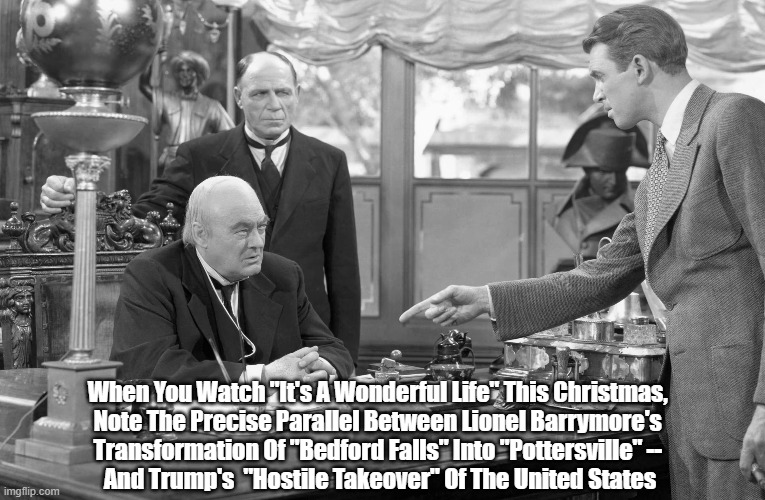
The Dystopian Pottersville In "It's A Wonderful Life" Is Starting To Feel Less Like Fiction
The Conversation
The Conversation is a web-based news and opinion outlet, based in Australia, which does very good work. https://en.wikipedia.org/wiki/The_Conversation_(website)
Robert Reich uses clips from "It's A Wonderful Life"
to describe why it isn't.
Yesterday, while watching "It's A Wonderful Life" -- by my lights the best movie ever made -- I was struck by the precise (and persistent) parallel between Lionel Barrymore's rendition of Henry F. Potter, a proto-capitalist-pig obsessed with converting the lovely town of "Bedford Falls" into a slumlord's "Pottersville."
In one notable scene, George Bailey (played by Jimmy Stewart), who manages Bedford Falls' Savings and Loan, describes his nemesis, commercial banker Henry F. Potter, as a man who profits from human squalor.
Such squalor calls to mind the 1975 adjudication by the United States' Department of Justice which found Trump and his father legally responsible for reprehensible behavior in their prejudicial rental policies that were consistently harmful to black tenants.
In the following AI response to my inquiry about George Bailey's critique of Henry F. Potter as a squalid slumlord, I draw your attention to the following passage:
"In the 1946 classic It's a Wonderful Life, George Bailey’s critical appraisal of Henry F. Potter—the wealthiest and most ruthless man in Bedford Falls—is characterized by moral indignation, physical revulsion, and a defense of the common man’s dignity. George views Potter not just as a business rival, but as a predatory force that treats human beings as disposable commodities."
Key Dimensions of George Bailey's Critical Appraisal Of Henry F. Potter
- A "Warped, Frustrated Old Man": George famously confronts Potter during a board meeting, labeling him a "warped, frustrated old man" who is unable to understand the value of people beyond their bank accounts. He argues that while Potter sees the working class as "lazy rabble," they are actually the backbone of the community who deserve the chance to own their own homes.
- Moral and Physical Revulsion: George’s distaste for Potter is visceral. When Potter offers George a lucrative job to dismantle the Building and Loan from within, George initially considers it but ultimately rejects it with a feeling of physical sickness. He describes shaking Potter’s hand as feeling like a "cold mackerel," symbolizing his disgust for Potter’s lack of human warmth.
- Defense of Human Dignity: George critiques Potter’s "slumlord" business model, specifically the "Potter's Field" housing where people are forced to live in squalor. George believes that providing affordable housing through the Building and Loan is a moral necessity to prevent Potter from owning "everything and everyone" in town.
- Recognition of Potter's Ruthlessness: George is one of the few who sees Potter’s true nature. He recognizes that Potter is "buying when everyone else is panicking," using financial crises to exploit the vulnerable. He views Potter as a "crony capitalist" who uses his power to manipulate the town's social and financial order for personal gain.
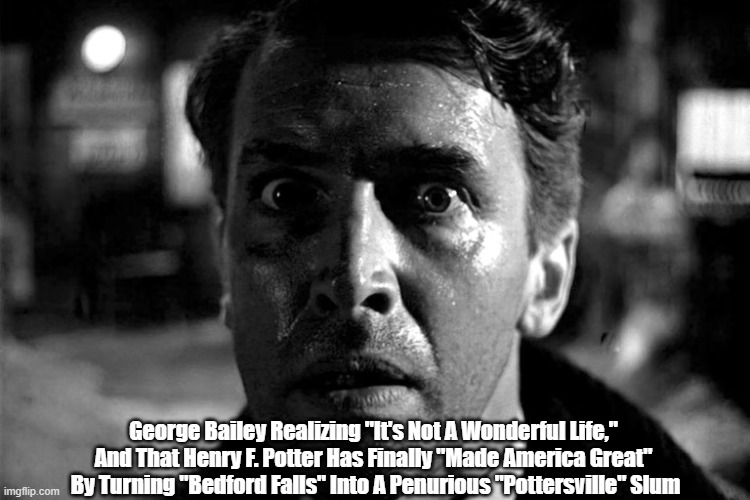
Of course, there are at least two sides to every story, but conservative Trump-loving Americans delight in being contrarian for contrarianism's sake.
Here is a classic example of how this intrinsically cruel, Trumpista mindset abuses core Truth "by being too clever by half."
The bottom line is this: If you like Henry F. Potter, you'll like Scrooge.
But to like either of these archetypal villains, some kind of "diabolical possession" has seized your spirit, twisting your psyche so that you find satanic vility "normal" - even virtuous!
"In Defense Of Mr. Potter"
Alan: In the following Postscript, AI provides a summary of the racial discrimination suit which the Department of Justice brought against Donald Trump and his father, Fred Trump, co-defendants in a major racial discrimination lawsuit concerning the Trumps' rental property practices as they related to people of color. The suit was filed by the U.S. Department of Justice (DOJ) and was settled with a damning consent decree in 1975
Postscript:
In the 1970s, Donald Trump and his father, Fred Trump, were named as defendants in a major
racial discrimination lawsuit filed by the U.S. Department of Justice (DOJ). The case was settled with a consent decree in 1975, which did not include an admission of guilt but imposed significant sanctions and requirements on the Trump management company to end discriminatory practices. Details of the Lawsuit and Settlement
- Allegations: The 1973 lawsuit alleged that the Trump Management company systematically refused to rent to Black applicants. Investigations using "testers" (individuals of different races posing as potential renters) found that available apartments were offered to white applicants but denied to Black applicants.
- Internal Practices: According to court filings and former employees, applications from people of color were allegedly marked with a "C" for "colored" or "No. 9" (a code for "colored").
- The Consent Decree: The settlement, described by the Justice Department as "one of the most far-reaching ever negotiated," included several "sanctions" or requirements. The Trumps were required to:
- Familiarize themselves with the Fair Housing Act.
- Place advertisements in minority newspapers to inform potential renters of equal opportunity housing.
- Provide a list of all vacancies to a civil rights organization.
- Ensure that welfare payments were counted as income when evaluating an applicant's financial qualifications.
- Subsequent Action: The DOJ later reopened the case in 1978, alleging that discriminatory conduct by Trump agents was still occurring frequently, though court records do not indicate how this second action was resolved.
More Recent Events
- Jared Kushner's Company: In more recent years, Jared Kushner's real estate company, Westminster Management, has faced separate legal scrutiny for tenant issues, including allegedly charging excessive late fees and pursuing evictions during the COVID-19 pandemic moratoriums. In 2024, a Maryland Supreme Court case ruled against the company regarding excessive late fees.
- Trump Administration Policy: During his presidency, Donald Trump's administration proposed rules that critics argued would weaken fair housing enforcement tools, such as the Disparate Impact Rule, which would disproportionately affect people of color.
- ****
- Unless you're in league with The Prince of Darkness (and your entire world is completely upside
- down), normal people consider Donald Trump a demonstrably bad man.
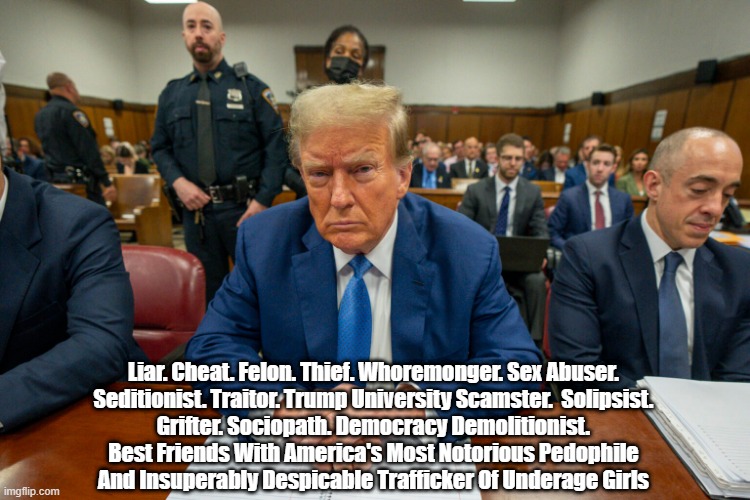
If you support Trump -- and also claim to be a Christian -- you are lying to yourself (and to the- world), and you should hang your head in shame.
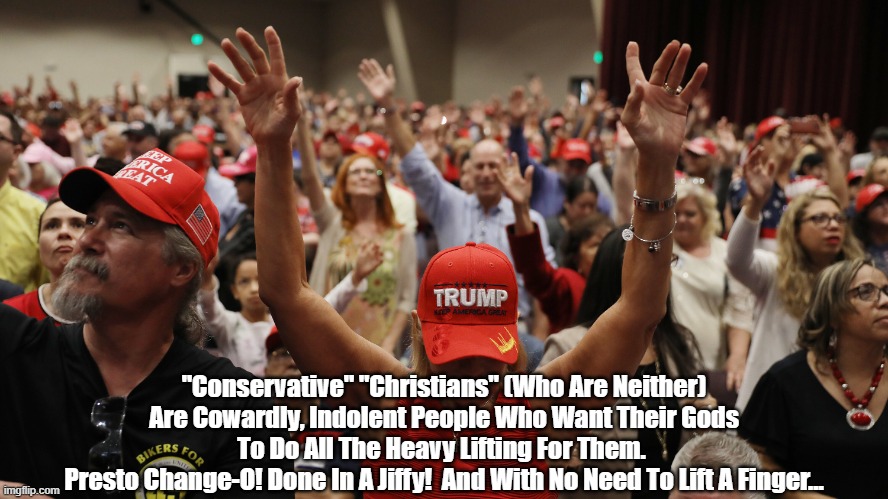
- Christianity: A Compendium Of "What Went Wrong" - And Current Worship Of The Wrongness
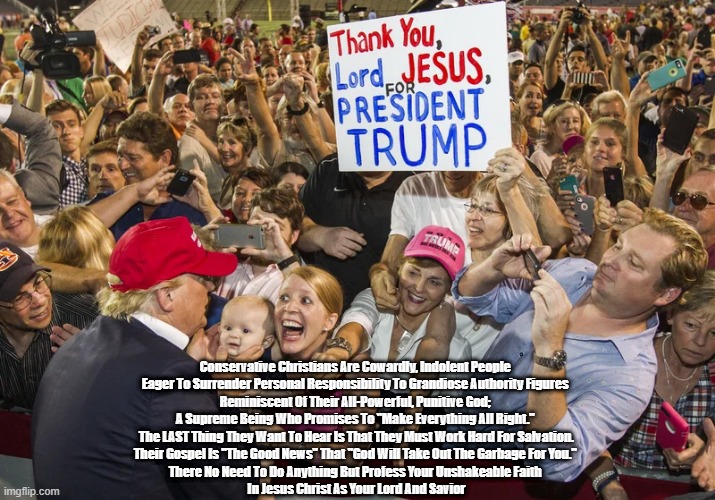
Compendium Of Christianity Posts: Why "Conservative" "Christians" Are All Going To Hell (If There Is A Hell...Which I Don't Believe)

No comments:
Post a Comment